
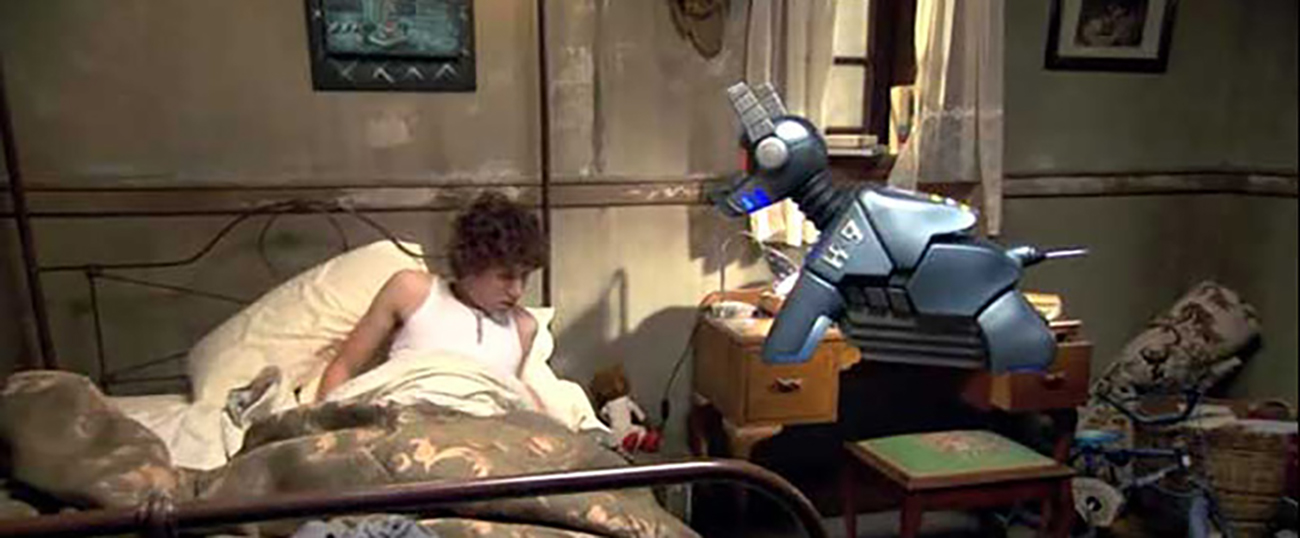
A mysterious device invades people’s dreams, and K-9 must dive into the realm of nightmares—proving that even a metal dog can have bad dreams (mostly about firmware updates).
Short Synopsis
When Londoners start falling into comas and muttering about “creatures in their dreams,” Gryffen and the gang discover an alien parasite feeding on human subconscious energy. To stop it, K-9 must enter the dream world himself—because apparently reality wasn’t complicated enough already.
Extended Storyline
The episode begins with what looks like a typical lazy day at Gryffen’s lab—until Starkey faceplants into his cereal and doesn’t wake up. At first, everyone assumes he’s just being his usual teenage self, but then they notice the energy readings: elevated brainwave activity, rapid-eye movement, and a faint psychic pulse coming from his head.
K-9 quickly deduces that Starkey’s in an artificially induced dream state. “Statement: Human operating system compromised. Recommendation: defragment the brain.” Gryffen is slightly less robotic in his concern but no more helpful, since his quantum scanners detect a low-level telepathic field sweeping through the city. Soon reports pour in—people everywhere are collapsing, trapped in unending sleep, all describing the same thing: The Dream-Eaters.
The Department, ever tactful, responds by declaring a “Sleep Emergency” and locking citizens in their homes. Inspector Drake insists the phenomenon is “a mass hallucination” (because she clearly skipped the class on obvious alien activity 101). But Jorjie’s motherly instincts kick in, and she asks K-9 for help. He politely declines her “authorization protocols,” because he doesn’t take orders from anyone with a badge.
Meanwhile, inside his coma, Starkey finds himself wandering a warped version of the lab—one where the rift glows blood-red, the equipment hums ominously, and all his friends have blank, eyeless faces. Classic Tuesday nightmare stuff. From the shadows emerges a skeletal, insectoid being with luminous eyes. It introduces itself in a voice that sounds like two radio stations fighting: “We are the Dream-Eaters. You dream. We feed.”
Back in the waking world, Gryffen and Jorjie piece together that a prototype “Sleep Enhancement Device” (read: alien tech disguised as a wellness gadget) has been distributed through the city. The Department apparently imported it as part of a “mental health initiative.” Instead, it’s channeling nightmares straight to the Dream-Eaters’ realm. Whoops.
With Starkey’s mind trapped and his life force draining, K-9 makes a bold decision: “Statement: To terminate infection, system infiltration required. Commencing neural interface.” In human terms—he’s going into the dream himself. Gryffen hesitates but finally connects K-9’s systems to Starkey’s brainwaves, muttering something about “cross-dimensional neural risk” and “how this is definitely a terrible idea.”
Cue the dream sequence: K-9 materializes in a surreal, shifting landscape made entirely of memories and fears. Buildings melt, clocks tick backward, and K-9’s once-slick armor now ripples with spectral energy. He encounters distorted versions of the gang—Jorjie accusing him of being “just a machine,” Gryffen begging for his family, Darius turning into mist. Even K-9 begins to glitch.
He eventually finds Starkey, trapped inside a pulsating cocoon while Dream-Eaters swarm overhead like psychic piranhas. K-9 uses logic-based defense protocols, creating a barrier of pure data that disrupts the creatures’ psychic link. But the lead Dream-Eater is persistent—it morphs into a giant, two-headed version of K-9, taunting him: “You cannot dream, so you cannot defeat us!”
To which our hero calmly replies, “Correction: I am dreaming now.” Then he does what only K-9 can—overloads his imagination matrix, turning the dreamscape into a field of blazing light and sound. The shockwave vaporizes the Dream-Eaters and severs their connection to the waking world. Starkey jolts awake, screaming, “Never again!”—which, let’s face it, could be the series motto.
The city wakes, the victims recover, and the Department takes credit (as usual). In the lab, K-9 reboots with a flicker of static. When asked what it was like inside the dream, he answers, “Statement: Unstructured reality is inefficient. Also, gravity fluctuated.” Which, from him, is practically poetic.