
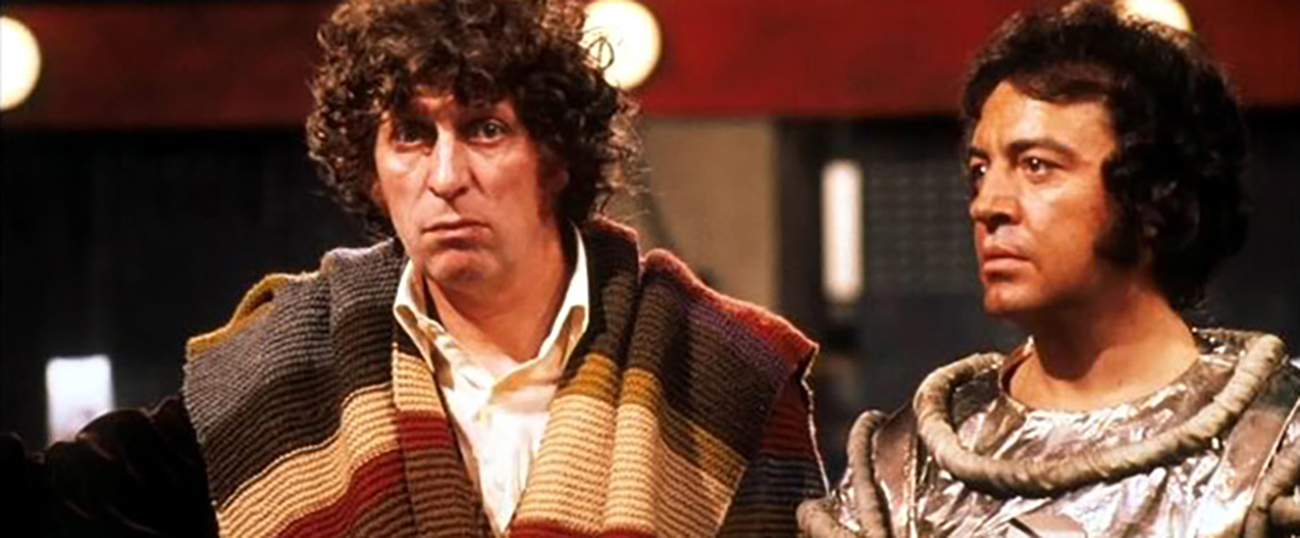
Greek mythology in space — now with 87% more tinfoil and awkward chroma key.
Short Synopsis
The Doctor and Leela stumble across a spaceship crew who’ve been searching for their missing “race bank” (basically a backup hard drive containing all their people’s DNA) for 100,000 years. What they find instead is a bunch of oppressed miners, dodgy gods, and a lot of recycled mythology.
Extended Storyline
The TARDIS lands aboard the spaceship R1C, crewed by a group of Minyans — a race the Time Lords once helped, long ago. Which, of course, went horribly wrong (because every time the Time Lords “help” a civilization, it ends with either mass destruction or endless bureaucracy). The Minyans are immortal now, courtesy of Time Lord technology, but instead of eternal bliss, it’s given them an eternity of grumpiness and a really long “to-do” list.
For 100,000 years, the Minyans have been searching for their lost “race bank,” the DNA repository containing the genetic material needed to rebuild their species. Unfortunately, their search has taken so long that they’ve mostly forgotten why they’re doing it, and just keep flying around space muttering, “Any day now.”
The Doctor, naturally, decides to help. After all, who doesn’t love a galactic scavenger hunt with existential stakes? Leela, meanwhile, just wants to stab something.
The R1C finally tracks the race bank to a nearby planet. But — twist! — the planet’s core has collapsed into a dense mass of rock, trapping the cargo ship P7E (the one carrying the race bank) deep within. And because the BBC didn’t have the money to actually build all these caves, everything from this point on takes place against shaky CSO (Colour Separation Overlay) backgrounds. Translation: our heroes are basically running around in front of a green screen that doesn’t quite match up, giving the whole story the aesthetic of a school play performed inside a lava lamp.
On the planet, the Doctor and Leela discover that the descendants of the original P7E crew have become slaves to a tyrannical computer system that poses as gods. The Trogs (yes, that’s what the miners are called — Trogs) are forced to dig endlessly through the rock, believing their labor keeps their gods appeased. In reality, they’re just fueling a cycle of exploitation that would make even The Sun Makers’ tax system look humane.
The “gods” are in fact the ship’s computer system, Oracles, who have taken on a Zeus-like role in the mythology of the Trogs. To keep control, the Oracle uses technology and threats, convincing the Trogs that endless toil is their only path to survival. Because nothing says “divine wisdom” like a machine that basically shouts, “Keep digging or else!”
The Doctor, being the Doctor, decides it’s time for a little revolution. With the help of Leela, the R1C crew, and a few rebellious Trogs, he sneaks into the Oracle’s chambers to retrieve the race bank cylinders. Trouble is, the Oracle has anticipated him and replaced the cylinders with two very special alternatives: nuclear bombs. (This is what happens when you trust a computer that thinks it’s a god. Alexa never does this.)
Cue a mad dash through collapsing caverns (or at least, slightly wobbly blue-screen caves) as the Doctor pulls his usual trickery, snatching the real cylinders and ditching the bombs. In classic Who fashion, the Oracle gets destroyed in the ensuing explosion, the slaves are freed, and the Minyans finally have what they’ve been looking for after 100,000 years.
The Doctor and Leela, naturally, duck out before anyone can rope them into actually rebuilding a civilization. They’ve got better things to do — like tea, sarcasm, and avoiding the BBC’s VFX department.