
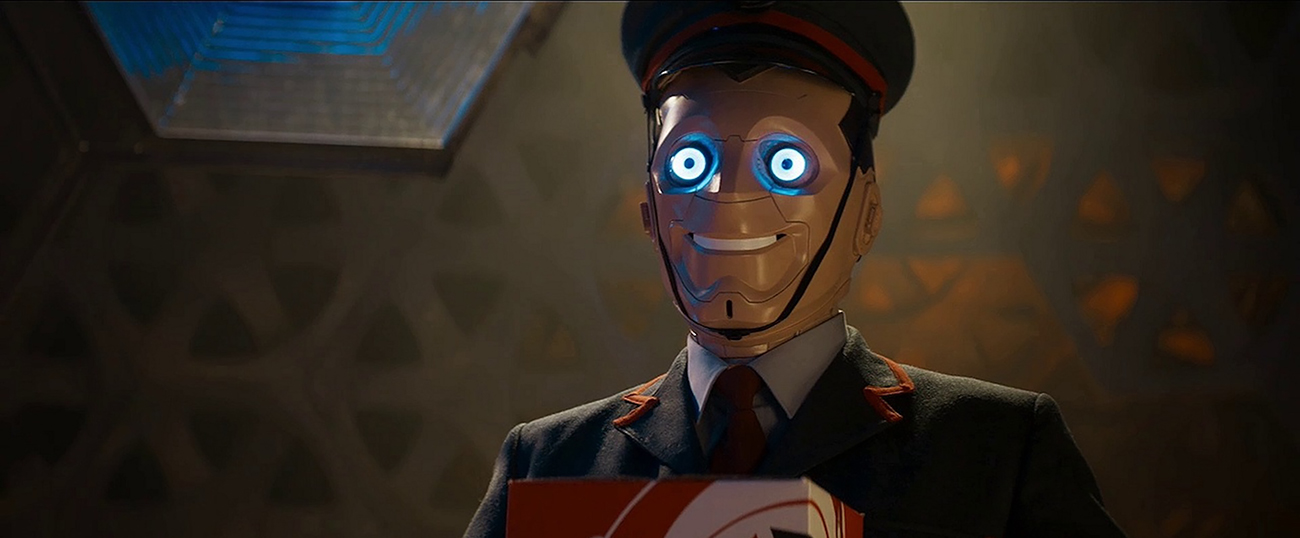
The Doctor and fam go undercover at Space Amazon to figure out why the delivery system is sending distress signals. Spoiler: the real horror isn’t the AI. It’s the human employee with a manifesto and way too much access to bubble wrap.
Short Synopsis
A distress call leads the Doctor, Yaz, Graham, and Ryan to Kerblam!, the galaxy’s largest delivery service. They go undercover as workers, where suspicious accidents and sinister management loom. But it turns out the machines aren’t plotting against humanity — one human is. With bubble wrap. Yes, bubble wrap.
Extended Storyline
The Doctor receives a package in the TARDIS — yes, apparently even the Amazon of the future knows how to bypass dimensional barriers. Inside: a fez? No, not quite. More importantly, it comes with a note that just says: “Help me.” And if the universe mails you a cry for help, you check the return address.
So off Team TARDIS goes to Kerblam!, the biggest, shiniest warehouse-slash-delivery service in the galaxy. Picture Amazon Prime, but with robots doing 90% of the work and cheery propaganda videos plastered on every wall. Their motto? “Kerblam! — delivery for the galaxy.” Their reality? A cross between Disneyland, a sweatshop, and a nightmare about conveyor belts.
The Doctor and companions split up to infiltrate different roles:
-
Ryan and Yaz land in the warehouse, complete with endless conveyor belts and packages zipping by at lethal speeds. (Ryan’s dyspraxia makes this a bit of a hazard, but Yaz, ex-police officer, handles it with grim competence.)
-
Graham gets stuck in packing, slapping labels on boxes and befriending a kindly older worker named Charlie, who seems a bit too nice.
-
The Doctor tries to snoop, but gets caught by HR. Which, in this case, stands for Horrible Robots.
Soon, it becomes clear something is rotten in the state of Space Amazon. Workers are vanishing, accidents are happening, and management is suspiciously cheery about it. The humans at the top, like supervisor Judy and floor manager Slade, are either overwhelmed or tight-lipped. Suspicion naturally falls on the robots — because of course it does. Killer robots are practically a tradition in Doctor Who.
But then comes the big twist: the robots aren’t the bad guys. They’re trying to help. The real culprit is Charlie, Ryan’s nice new work buddy, who turns out to be a radical anti-automation activist. He’s furious that humans are losing jobs to machines, and his big plan to make a point is… sabotage the system so every Kerblam! delivery contains bubble wrap bombs. (Yes, bubble wrap. The universal temptation. Who wouldn’t pop it?) His idea is that when millions of customers die, people will finally turn against automation. Logic: not his strong suit.
The Doctor, appalled, realizes the AI system sent the distress call because it didn’t want to kill people. (Honestly, this might be the only time in sci-fi where the mega-corporation’s AI is the hero.) With seconds to spare, the Doctor rewires the system, reroutes the deadly packages, and ensures Charlie’s plan backfires. He dies in his own explosion, and the rest of the staff are left to pick up the pieces — literally, since Kerblam! is still very much in business.
The Doctor gives one of her trademark bittersweet speeches about how automation isn’t inherently bad, but people have to use it responsibly. Everyone nods. The audience mutters something about Jeff Bezos under their breath.