
When your fossilized skull starts glowing and whispering dark secrets, it’s probably not just a migraine.
Short Synopsis
The Doctor and Leela stumble into an English countryside mansion where a group of scientists are experimenting on a mysterious human skull that may predate humanity itself. Surprise! It’s an alien parasite that feeds on life-force and has been hanging around Earth since the dawn of time. Things get very culty, very fast.
Extended Storyline
It begins, as many great horror tales do, with a mysterious skull. Dr. Fendelman (yes, that’s his actual name — subtlety is not this show’s strength) and his team of scientists have found a human-like skull that’s two million years old. That’s odd, considering Homo sapiens were still busy learning how not to trip over rocks back then. Even stranger, the skull seems to absorb and emit energy, as though it’s been binge-watching Doctor Who cliffhangers for centuries.
Enter the Doctor and Leela, who track a time disturbance to the research site. They quickly discover that the skull is no ordinary fossil — it’s a remnant of the Fendahl, an ancient alien lifeform so dangerous that the Time Lords tried to erase all record of it. (This is yet another example of Gallifrey’s “out of sight, out of mind” policy, which usually works about as well as putting duct tape over a smoke alarm.)
The Fendahl feeds on the life energy of others and manipulates humanity through psychic influence. Naturally, one of the scientists, Thea Ransome, becomes possessed by the skull and slowly transforms into the Fendahl Core — complete with glowing eyes, golden robes, and all the presence of a malevolent ghost who got into your wardrobe.
Meanwhile, the cult subplot kicks into gear. Because what’s a creepy manor house story without a local coven of villagers who’ve apparently been worshipping the Fendahl for centuries? Led by the sinister Mother Tyler (who, to be fair, steals every scene she’s in), the cultists are more than happy to help usher in the alien’s resurrection. You know, because nothing ever goes wrong when you help ancient skulls manifest godlike parasites.
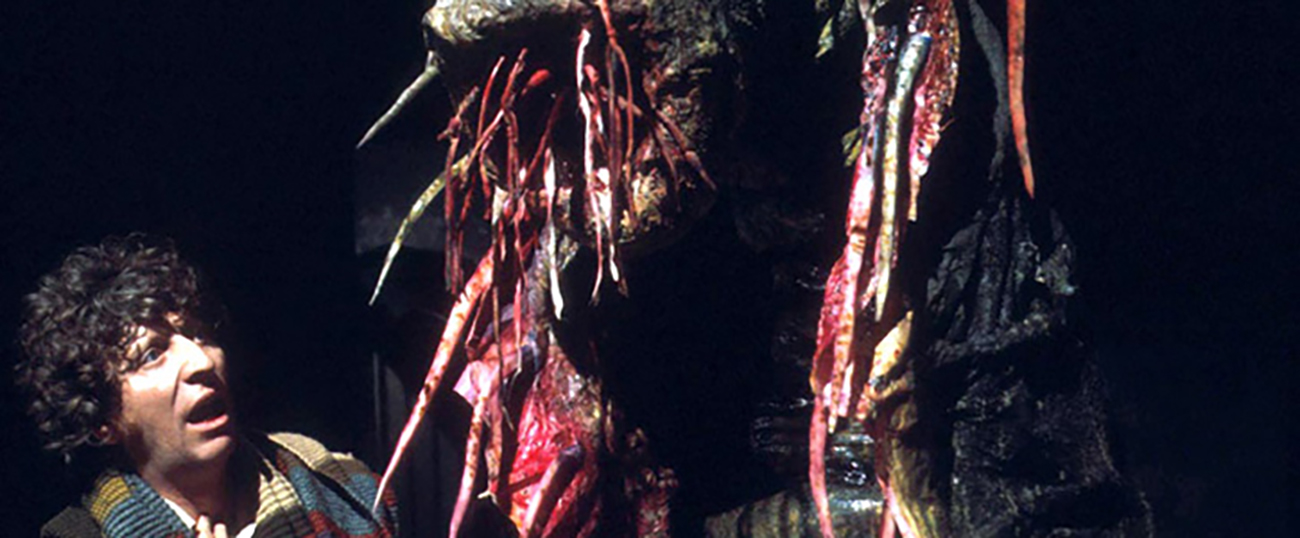
As the Fendahl grows stronger, it creates minions called Fendahleen — giant worm-like creatures that slither about draining life energy. Imagine lampreys crossed with vacuum cleaners, and you’re in the right ballpark. One by one, the scientists and cultists are drained or transformed, while the Doctor scrambles to stop a cosmic parasite that feeds on death.
The Doctor realizes the only way to defeat the Fendahl is to contain it. Using a handy Time Lord gadget — the ridiculously named “time loop” — he traps the skull in a perpetual loop before it can reach full power. The house is destroyed, the cult is broken, and humanity dodges another ancient alien apocalypse.
Leela, meanwhile, spends most of the story rolling her eyes at the stupidity of humans who worship evil worms, occasionally stabbing things, and befriending the delightfully eccentric psychic grandmother, Mrs. Tyler. (Who may actually be tougher than Leela. Don’t argue with a woman who makes tea and banishes eldritch horrors before lunch.)
In the end, the Doctor chucks the Fendahl skull into a supernova — the interstellar equivalent of tossing it in the trash and setting it on fire — and the TARDIS crew leaves, having once again saved Earth from being turned into a cosmic buffet.