
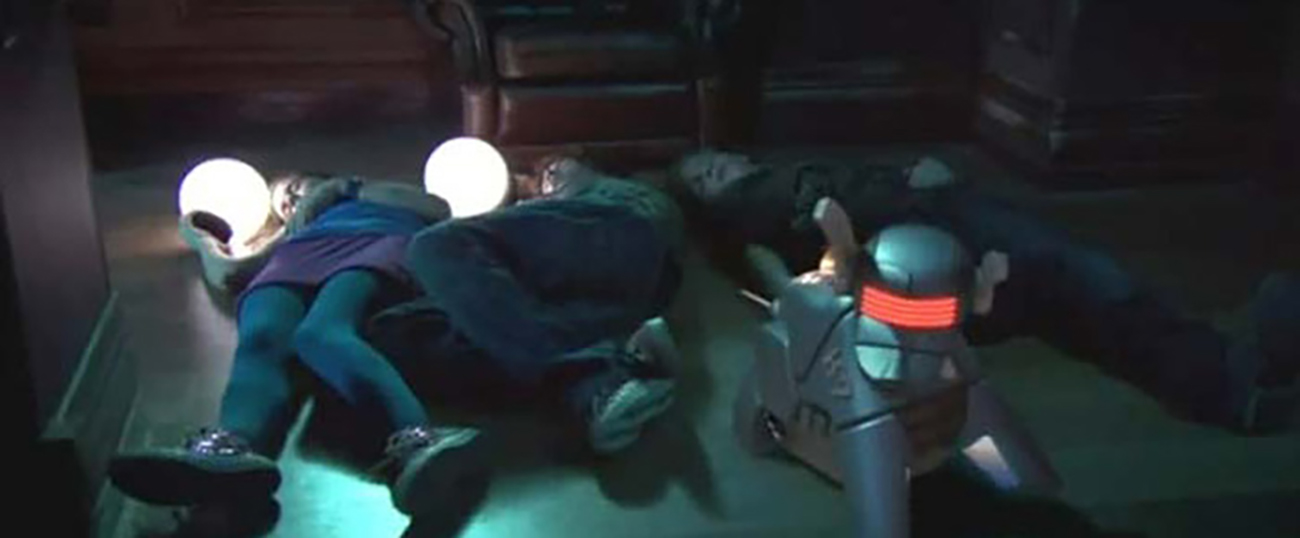
When the lab starts acting haunted, Gryffen’s sanity wobbles, the kids panic, and K-9 discovers that ghosts are just physics having an existential crisis.
Short Synopsis
The mysterious rift in Gryffen’s lab starts behaving like a bad mood with Wi-Fi—opening portals, moving furniture, and unleashing what might be ghosts. As Gryffen unravels under the weight of his past, K-9 must untangle the truth: not all hauntings are supernatural… but they’re still a pain to clean up.
Extended Storyline
Things start quietly—always a bad sign in Gryffen’s lab. The Professor is brooding (again), Starkey’s playing music too loud, Darius is poking at alien tech he definitely shouldn’t touch, and Jorjie’s pretending not to care while secretly recording everything for “research.”
Then the lights flicker. Equipment powers on and off by itself. The air grows icy cold, and a holographic distortion resembling a human form glides through the lab wall. Everyone freezes. Gryffen, naturally, goes pale as the apparition seems to whisper his name.
“Statement,” K-9 says flatly. “Spectral manifestation detected. Probability of supernatural origin: zero percent.”
But Gryffen’s not so sure. The Professor’s already fragile nerves start to fray as more strange events occur: doors slam by themselves, data files vanish, and holograms of his late wife and son appear in the corridor—again. (Because nothing says “family trauma” like recursive holographic grief.)
The gang suspects that the rift may be destabilizing, leaking energy from other dimensions. Gryffen insists that his family is reaching out to him, and the others don’t have the heart to argue—until the house begins trying to kill them.
Tables levitate, tools hurl across the room, and a terrifying energy pulse knocks out the lab’s power grid. Starkey suggests leaving (as any sane person would), but Gryffen refuses—determined to communicate with what he believes are echoes of his family. He activates the rift stabilizer manually, prompting K-9 to issue what may be his first ever exasperated sigh.
K-9 traces the interference to a temporal displacement node—a fancy term for “the universe having indigestion.” Apparently, the rift has snagged fragments of Gryffen’s memories and is projecting them into reality. In short: the “ghosts” aren’t souls, they’re data phantoms—psychic imprints looping through the rift’s energy like corrupted files.
But here’s the kicker: the node is becoming self-aware. It’s begun to mimic Gryffen’s thoughts, feeding on his guilt and fear, essentially forming a Gryffen-shaped ghost AI. The entity now believes it is the real Gryffen, and naturally wants to replace him. Because identity crises are always better with a malevolent clone involved.
The showdown that follows is as psychological as it is physical. Gryffen is trapped in a simulation of his past, forced to relive the accident that killed his family. Meanwhile, the others work frantically to restore power while dodging poltergeist-level physics. Darius yells something about “quantum exorcism,” and Jorjie distracts the entity long enough for K-9 to do what he does best—fire a precision plasma bolt directly into the rift stabilizer.
The blast resets the energy field, purging the rogue echo and sealing the dimensional breach. The lab is wrecked (again), Gryffen is shaken but alive, and K-9’s metal casing is lightly scorched, which he insists adds “character.”
In the aftermath, Gryffen quietly admits he’s been holding on to the past for too long. Starkey offers an awkward but heartfelt “We’re your family now, Professor,” prompting a rare smile. K-9 interrupts with: “Observation: sentimentality levels reaching hazardous concentrations. Suggest ventilation.” Classic.