
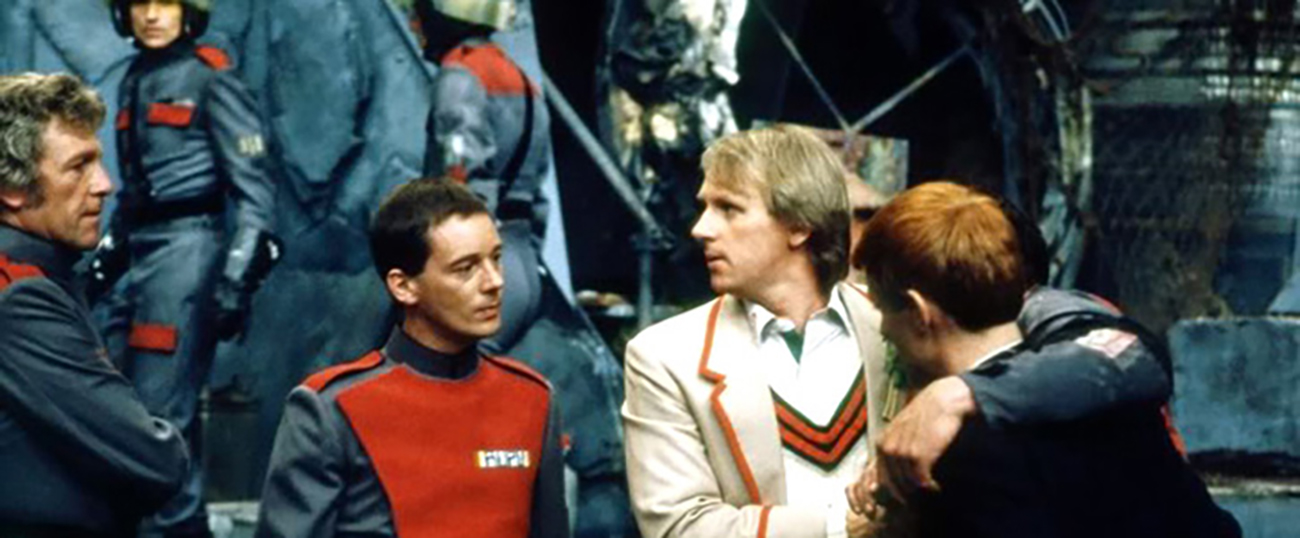
Humanity’s last hope, an alien insect infestation, and the Doctor pretending he definitely didn’t just lose the TARDIS again.
Short Synopsis
The Doctor, Tegan, and Turlough arrive on Frontios, one of the last human colonies. They find terrified colonists under constant meteor bombardment — which, surprise, isn’t natural at all. Instead, it’s the work of the Tractators: giant telekinetic woodlice with plans to turn humans into glorified mining equipment.
Extended Storyline
Far in the future, humanity has fled Earth and scattered to the stars. One of the last colonies is Frontios, a bleak and hostile planet where survival is more of a hope than a plan. The Doctor decides it’s high time for a morale-boosting visit, despite the Time Lords’ strict rule that he’s not supposed to interfere this far in human history. But when has “don’t interfere” ever worked out for him?
On arrival, the TARDIS crew discover the colonists in a dire state. Supplies are low, leadership is shaky, and morale is sinking faster than the colony’s bunkers. Captain Revere, the colony’s leader, dies under mysterious circumstances, leaving his wet blanket of a son, Plantagenet, in charge. Plantagenet has all the leadership qualities of a damp crumpet but insists on barking orders anyway.
Things only get worse when the colony comes under a relentless meteor bombardment, smashing their settlement into rubble on a regular basis. Everyone assumes it’s just bad luck, but the Doctor quickly suspects something more sinister. He’s right, of course — the meteors are being aimed by the Tractators, a race of giant insects who look like woodlice designed by someone with a grudge against the forestry commission.
The Tractators have telekinetic powers, which they use to pull the colonists underground and enslave them. Their grand plan? Turn humans into living engines, strapping them into giant burrowing machines to dig out an underground empire. It’s basically a cross between mining, slavery, and the worst DIY home renovation project in history.
As usual, the Doctor gets caught trying to help. In the chaos, the TARDIS appears to be destroyed by one of the meteor strikes — reduced to fragments scattered across the landscape. This sends the Doctor into a panic, since “losing the TARDIS” is slightly worse than “losing the car keys,” especially when it’s a car key to all of time and space. (Don’t worry, the TARDIS is mostly fine. It just needed some off-screen plot magic to reassemble later.)
Meanwhile, Turlough, who has spent most of his time trying to avoid work, suddenly gets the spotlight. He has a full-on nervous breakdown because he recognizes the Tractators from his homeworld’s folklore — terrifying childhood stories of unstoppable burrowers who consume entire planets. This makes him both the most scared and, ironically, the most useful companion for once.
Eventually, the Doctor infiltrates the Tractators’ lair and comes face to face with their leader, the Gravis. Unlike the rest of his insectoid chums, the Gravis has the brainpower to direct them all telepathically. The Doctor hatches a plan: if he can separate the Gravis from the swarm, the rest of the Tractators collapse into a sort of catatonic woodlouse nap. With some quick thinking (and a bit of TARDIS trickery), he manages it, neutralizing the threat.
The colonists are saved, the meteors stop, and humanity gets another chance to scrape by in the far future. The Doctor slips away, having interfered spectacularly despite his best intentions not to.